
Barnsley Football Club is a professional football club in Barnsley, South Yorkshire, England. The club competes in EFL League One, the third tier of English football.
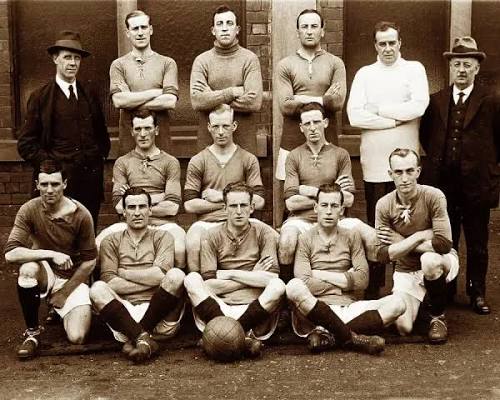
Nicknamed “the Reds”, "the Tykes" or less commonly "the Colliers", they were founded in 1887 by Reverend Tiverton Preedy and moved to Oakwell the following year. The club's original blue colours were changed to red and white in 1904. Barnsley spent the 1890s in the Sheffield & District, Midland and Yorkshire leagues, before gaining admittance to the Football League Second Division in 1898. They twice reached the final of the FA Cup whilst still in the second tier, losing to Newcastle United in 1910 and winning the competition over West Bromwich Albion in 1912. The club suffered relegation in 1933, but secured promotion as Third Division North champions in 1934. They won the Third Division North title for a second time in 1939, having been relegated the previous season.
Barnsley were established in 1887 as Barnsley St Peter's by Reverend Tiverton Preedy, and they played in the Sheffield and District League from 1890 and in the Midland League from 1895. In 1897, the club dropped the St Peter's part of its name to become simply Barnsley. They joined the Football League in 1898, and struggled in the Second Division for the first decade, due in part to ongoing financial difficulties. In 1910, the club reached the FA Cup final, where they were defeated by Newcastle United. In 1912, they reached the FA Cup final again, and defeated West Bromwich Albion 1–0 to win the trophy for the first time in their history. When league football restarted after the First World War, the 1919–20 season brought some significant changes to the league. The main difference was that the First Division would now have 22 teams, rather than 20. The bottom team from the previous season was Tottenham Hotspur and they were relegated. The first extra place in the First Division went to Chelsea, who retained their place despite finishing second bottom and therefore in the relegation places. Derby County and Preston North End were promoted from the Second Division which left one place to be filled.
Having finished the previous season's Second Division in third place, Barnsley expected to achieve First Division status for the first time, but the Football League instead chose to call a ballot of the clubs. The League voted to promote sixth-placed Arsenal, prioritizing historical standing over sporting merit. Sir Henry Norris, the then Arsenal chairman, argued that Arsenal be promoted for their "long service to league football", having been the first League club from the South of England. It has been alleged that this was due to backroom deals and even outright bribery by Sir Henry Norris, colluding with his friend John McKenna, the chairman of Liverpool and the Football League, who recommended Arsenal's promotion at the AGM. No conclusive proof of wrongdoing has come to light, though other aspects of Norris's financial dealings unrelated to the promotion controversy have fuelled speculation on the matter. Norris resigned as chairman and left the club in 1929, having been found guilty by the Football Association of financial irregularities; he was found to have misused his expenses account, and to have pocketed the proceeds of the sale of the Arsenal team bus.
The club came close to reaching the First Division in their early years. In the 1921–22 season, they missed out on promotion by goal difference. During the 1930s and 1940s years, the club found themselves sliding between the Second and Third Division. In 1949, the club signed Danny Blanchflower from Glentoran, and he impressed at Oakwell that two years later he was signed by First Division side Aston Villa, later signing for Tottenham Hotspur and being voted FWA Player of the Year twice, as well as being the captain of the 20th century's first league and cup double winning team in 1960–61. Around the time of Blanchflower's departure, a young centre-forward called Tommy Taylor broke into the Barnsley team, scoring 26 goals in 44 games. In April 1953, he became one of the most expensive players in English football at the time when Sir Matt Busby signed him for Manchester United for a fee of £29,999. Taylor went on to be a prolific goalscorer at the highest level over the next five years, winning two league titles and scoring 16 goals in 19 appearances for the England national football team, before losing his life in the Munich air disaster on 6 February 1958.
When the Northern and Southern sections of the Third Division were replaced by national Third and Fourth Divisions for the 1958–59 season, Barnsley were still in the Second Division, but went down to the Third Division at the end of the season. In 1965, Barnsley were relegated to the Football League Fourth Division for the first time, winning promotion three years later. They went down to the Fourth Division again in 1972, and this time stayed down for seven seasons, finally returning to the Third Division in 1979. Two years later, they went up again and quickly established themselves as a decent Second Division side throughout the 1980s, although they still failed to clinch that elusive First Division place, despite the introduction of the play-offs in the second half of the decade, which gave teams finishing as low as fifth and eventually sixth the chance of winning promotion.